

Prefer something a little more traditional? Does your heart beat faster when the hull ploughs through the water? Then a powerboat with a trawler hull is exactly what you're looking for! Choose from thousands of listings on Boat24. Here you'll find your dream boat with a trawler hull.
Continue readingTrawlers for Sale
Pushes the H2O aside
Refine results
Current listings
- Favorite
- TOP
Trawler
Vri-Jon Contessa 37R40s/CE
- 11.20 x 3.80 mDimensions
- 115 hpEngine power
Switzerland » Lake Murten
- Favorite
- Incl. trailer
- Favorite
Trawler
Pedro 950 Fly
Boat slip included / only 300.- per year / Like-new engines!!
- 11.00 x 3.30 mDimensions
- 2 x 75 hpEngine power
Murten
- Favorite
Trawler
Holterman & De Vries Blauwe Hand SL 38
12.35-meter steel motor yacht, with documented maintenance records since 2014
- 12.35 x 3.85 mDimensions
- 150 hpEngine power
Lake Geneva » Lausanne, port d'Ouchy
- Favorite
Trawler
Harris 20 Cruiser Grand BI
OPPORTUNITY: Pontoon boat with outboard motor
- 3.06 x 2.42 mDimensions
- 90 hpEngine power
Lake Lucerne » 6454


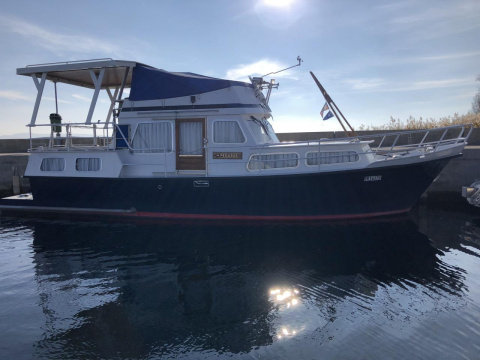

Trawler Motor Yacht
Unlike a planing boat, a trawler always stays in its element, even at higher speeds. It literally pushes the water aside or plows through the waves.
Content
What is a trawler?
A boat with a displacement hull quite literally displaces the water, pushing the H2O aside and plowing through the wet. Under way – assuming a flat water surface without any swell – a trawler stays almost completely in the water with its underwater hull.
Displacement hull shapes are used on powerboats and sailboats, or motor yachts and sailing yachts.
Unlike a planing boat, whose hull shape allows it to lift partly out of the water as speed increases, the trawler always stays in its element. Incidentally, every boat lying still in the water, making neither headway nor sternway, is a displacement craft: it displaces exactly the same amount of water as the boat's own weight (Archimedes' principle). Which in turn is the reason why we don't talk about the weight of a boat or ship, but about its displacement.
The hull shape of the trawler
Even at low speed, in principle all boats are still displacement craft. The hull shape of the trawler, however, does not allow the boat to move faster than its hull speed (the maximum top speed for a given hull shape), since it cannot lift even partly above the surface of the water. That is what defines the trawler principle – the stern of a trawler cannot overtake its own bow wave, because the resistance at the bow wave increases as speed rises.
Offshore sailors in particular know the phenomenon that trawlers can nevertheless travel faster than their hull speed, for example when surfing down a wave. This can result in the bow burying itself in the wave ahead of the boat, or in the dreaded broaching of the yacht on the ride down into the trough.
The semi-displacement trawler
One special trawler variant is the semi-displacement trawler, built from the 1970s onwards. With this boat type, a hull shape that was originally purely displacement was modified so that the boats can start planing in the aft section above a certain speed.
Who should buy a trawler?
A trawler should be your first choice if …
- speed isn't everything
- you want to cover long distances safely
- family-friendliness matters more than sportiness
- cabin, living space etc. are especially important


 Succes